New Year
Sir Gawain and the Green KnightNew Year gives the poem’s adventure its measure and its turning point. The Green Knight makes a year-and-a-day deadline part of his challenge, so the festive calendar at Camelot becomes a countdown to Sir Gawain’s return. As seasons pass, New Year shifts from a distant condition of the bargain to the immediate threshold of danger, and finally to the moment when the agreement is tested and the Green Knight’s identity is disclosed.
The calendar and the adventure’s beginning
The poem opens at Christmas in Camelot, where King Arthur is among the lords of the Round Table. Its account of Britain’s history gives way to an adventure presented as a marvel, and the courtly feast establishes a setting in which a challenge can become public spectacle. The calendar is therefore present from the outset as part of the world of ceremony and communal gathering, not merely as a way to date later events.
The narrative then marks the passage beyond Christmas: Lent follows, with its plainer food, and the seasons continue in succession. Sir Gawain remains with Arthur until All Hallows’ Day, when a feast is made for the company. Later, Saint John’s Day is identified as the last of the festivities, after which guests prepare to leave in the morning. These named observances make the movement of time legible across the poem. The year is not reduced to an abstract interval; its approach is registered through recurring feasts, seasons, and changes in the court’s activity.
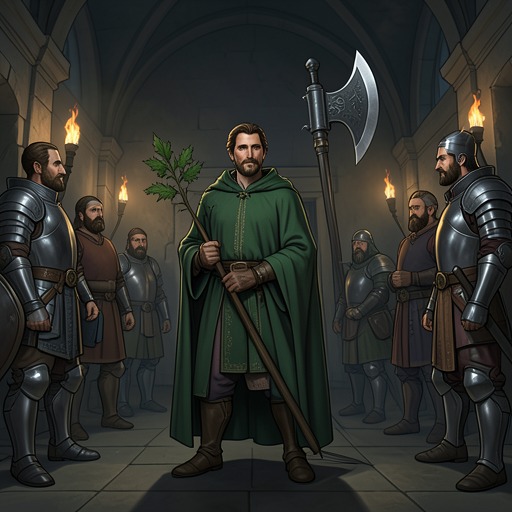
That calendar also carries the adventure outward from Camelot. On the morning after the court’s preparations, Sir Gawain rides into a deep, wild forest. The contrast between the ordered company and the lonely journey gives the passage of time a spatial consequence: a courtly promise made amid Christmas celebration leads into travel through an unfamiliar landscape, toward a meeting fixed for the next New Year.
A year and a day as a binding term
The deadline originates in the Green Knight’s challenge. After Sir Gawain strikes him, the Green Knight allows a year and a day before the answering blow. Sir Gawain makes the return obligation explicit: at the appointed time, he will take a blow from the challenger, using whatever weapon the Green Knight chooses, with no other person intervening. The length of the interval makes the bargain more than an immediate contest of courage. It gives the court time to resume its ordinary life while leaving a future encounter unresolved.
New Year thus functions as a promise that can be remembered and measured. The challenge begins at Camelot, but its consequence reaches beyond the feast and outlasts the initial astonishment. The text’s seasonal markers show the intervening year passing, while the approaching deadline gradually changes the meaning of the calendar: each observance belongs both to its own place in the year and to the interval Sir Gawain must complete before returning to the Green Knight.
At the castle, when New Year is the only part of the year still remaining, Sir Gawain speaks of his anxious journey. The lord laughs and says he will guide him to the Green Chapel when the term arrives. This assurance briefly makes the deadline seem manageable, but it cannot cancel the original agreement. The meeting place and the appointed time remain the goal toward which the journey is directed.
New Year at the castle
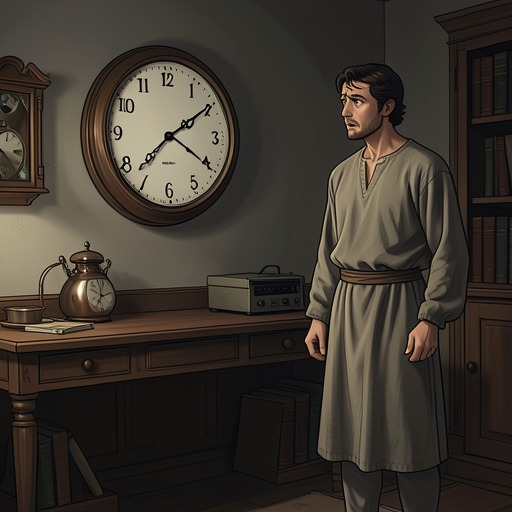
When the deadline is close, the poem gives New Year an intimate, domestic setting. On New Year’s Eve, the company drinks, converses, and recalls the same matter. Sir Gawain asks leave to depart in the morning because the appointed term is near. The episode places hospitality beside obligation: he has been staying among his hosts, but the calendar now requires him to leave their company and proceed toward the encounter he promised to face.
This moment gathers together the poem’s two kinds of time. The castle’s conversation and drinking belong to a shared evening, while the year-and-a-day agreement imposes a larger measure that Sir Gawain cannot set aside. His request to leave is not simply a change of lodging; it is the practical consequence of a promise made at the beginning of the year’s cycle. The New Year festivities provide a threshold between welcome and departure, and between the relative safety of the castle and the danger awaiting him.
As New Year approaches, night passes and the day darkens amid wild weather. The seasonal scene accompanies the movement toward the meeting, giving the final approach a harsher atmosphere than the Christmas gathering in Camelot. The poem does not need a new challenge to renew the danger: the turning calendar itself brings the old one due.
Fulfilment and significance
At the Green Chapel, the Green Knight recalls the terms with precision: at this time a year earlier, Sir Gawain received the blow, and now, at New Year, he is to be repaid. The wording connects the present encounter directly to the opening bargain. Time is not a loose background to the action but the means by which the challenge becomes enforceable; the interval has run its course, and the promised return can no longer be postponed.
The reckoning also leads to an identity disclosure. When Sir Gawain asks the other man’s name, he is told that he is Bertilak de Hautdesert, and that Morgan le Fay’s power is involved. The New Year meeting therefore joins the fulfilment of the physical challenge to the revelation of who has arranged the test. The date that once seemed only to impose a distant obligation becomes the point at which the adventure’s hidden design is made explicit.
Across the poem, New Year binds together courtly celebration, travel, hospitality, and danger. Christmas begins the narrative at Camelot; the named feasts and seasons register the passing interval; New Year’s Eve prompts Sir Gawain’s departure from the castle; and New Year at the Green Chapel makes the original agreement present again. Its significance lies in that repeated change of function: first a term granted by the challenger, then a date approaching through the calendar, and finally the occasion on which the promise is answered.